2. Modern pedagogical approach
New educational models require a change in the entire so-called traditional learning and teaching process and the organization of a modern educational environment that will be based on modern educational theory. Bransford et al. define three basic forms of organization of the teaching process that can be applied in an electronic educational environment: Student-oriented, knowledge-oriented, and evaluation-oriented education (Figure 1). By combining these three forms, we create an ideal educational environment for the creation of active and professional individuals, or so-called 21st-century citizens who are ready for life in a knowledge society (Banek Zorica, 2014).
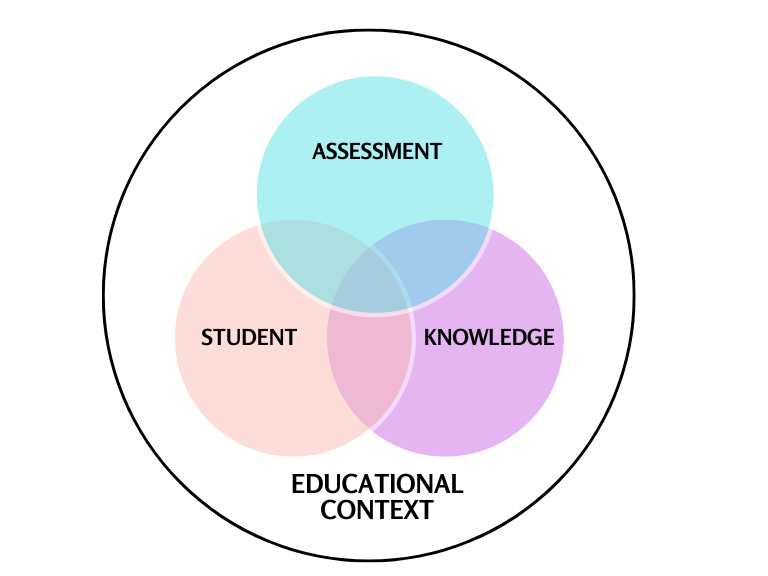
Student-oriented environment
This term is used to describe an environment that pays special attention to the knowledge, skills, attitudes, and beliefs that students bring to the educational setting. This concept seeks to uncover students' opinions and attitudes towards a particular issue, while sensitively discussing their possible "misconceptions", offering them insight into different situations that they need to think about and draw certain conclusions. In this way, it seeks to enable them to adapt their ideas and build on the conceptual and cultural knowledge they bring with them to the educational setting.
Student-centered environments involve teachers who are aware that students construct their own meanings and draw on their beliefs, understandings, and cultural practices to make their teaching. If teaching is about building connections between the subject and the student, in this form of teaching, teachers strive to take both sides into account. Teachers strive to gain insight into what students know and what their interests and passions are: what each student knows, what is important to them, what they can do, and what they want to do. They then focus on connecting these prior experiences with new insights and understandings of the problem.
Knowledge-oriented environment
A knowledge-oriented environment aims to develop learners into knowledgeable individuals by teaching in ways that promote deep understanding and the transfer of knowledge. An expert’s ability to think and solve problems does not depend solely on a general set of “thinking skills” or strategies; rather, it requires well-organized knowledge that supports planning and strategic thinking. This approach is closely linked to learner-centered environments, particularly in situations where teaching builds on learners’ prior knowledge and initial understanding of a specific subject or concept. If the knowledge that learners bring to different educational situations is not taken into account, it becomes difficult to predict what they will understand from new information (Banek Zorica, 2014).
Knowledge-oriented environments also emphasize the types of information and activities that help students develop a meaningful understanding of specific disciplines. If students are not provided with all the key information related to a particular problem or topic, their understanding may be incomplete or misguided. In addition to presenting facts, it is essential to foster an understanding of problems and events by examining them from multiple perspectives in order to draw valid and well-founded conclusions.
Many traditional curriculum models tend to produce fragmented knowledge and isolated skills rather than organizing them into coherent wholes. Such models often fail to support the gradual and structured refinement of students’ informal ideas through the adoption of the concepts and procedures characteristic of a particular discipline.
The activities used in knowledge-oriented learning environments are designed to enable students to explore, explain, extend, and evaluate their own learning. Ideas are most effectively adopted when students recognize the need to apply them, as this allows them to see the relevance of knowledge and better understand what they have learned. One of the key challenges of knowledge-oriented environments is achieving a balance between activities that support conceptual understanding and those that promote the automation of skills necessary for effective performance.
Contemporary theories of education emphasize active student engagement and are supported by research into brain functioning. Studies have shown that learning activities bring about changes in neural structures, not by chance, but through the formation and reorganization of new neural connections. In these dynamic processes, both social and environmental factors play a significant role. As a result, modern teaching increasingly draws on theoretical approaches such as constructivism and connectivism (Špiranec & Banek Zorica, 2008).
Examples of modern approaches to teaching at HEI (not referring to actual courses!)
Examples of modern approaches to teaching in higher education reflect a shift from the passive acquisition of knowledge toward active learning and student participation. For example, in the Marketing course at a Faculty of Economics and Business, students may work in small groups on market research projects and develop their own marketing campaigns, which they then present to their peers. In the Engineering Project course at the Faculty of Mechanical Engineering, students may address real-world problems through teamwork, using specialized software tools, and receiving guidance from instructors. Similarly, in the Language Teaching Methodology course at a Faculty of Humanities and Social Sciences, students may participate in simulated teaching sessions, record their performances, and analyze them through joint discussion and feedback, thereby developing reflective and professional competencies.
Background Colour
Font Face
Font Size
Text Colour
Font Kerning
Image Visibility
Letter Spacing
Line Height
Link Highlight
Paragraph Width
Text Alignment