4. SAM model
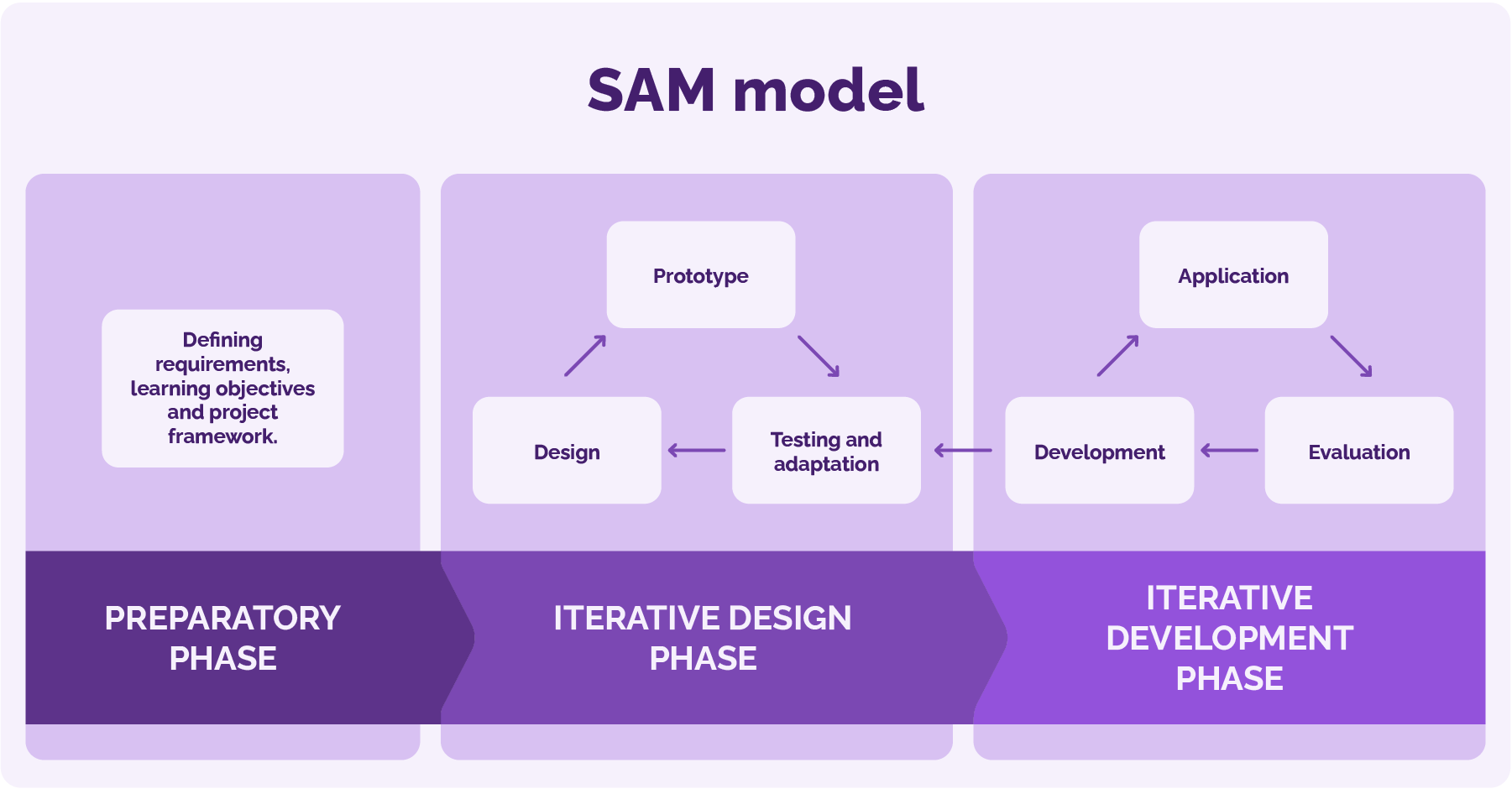
SAM model (Successive Approximation Model)
Due to the fact that when applying the ADDIE model, adjustments are introduced only after evaluation, a need arose for a more flexible approach that allows for continuous evaluation and adjustment during development. SAM3 (Successive Approximation Model) was designed to overcome these limitations. It is based on an iterative process in which design, development, and evaluation are carried out in parallel and cyclically. This approach allows for faster feedback and adjustments, reducing development time and increasing compliance with user needs.
It consists of a preparation phase, a design phase, and a development phase, with the design and development phases being repeated in at least three iterations. Each iteration is based on feedback and evaluation of the previous iteration.
The preparatory phase begins with defining the project's goals and gathering information about the target group. It includes understanding students' needs, learning styles, and the prior knowledge and competencies they need to acquire. This phase often results in the creation of initial sketches that serve to test ideas and serve as a basis for planning further development.
During the design phase, initial versions of educational content and activities are created, which are constantly tested and improved based on the feedback included in each iteration. With each iteration, the design becomes more detailed and customized.
Finally, in the development phase, the solution is finalized in several versions (alpha, beta, and final version). Each version is evaluated and improved based on feedback, which ensures the optimal quality of the final product (Tomić, 2025).
The peculiarity of the SAM model is in the dynamic management of feedback: instead of the evaluation taking place exclusively at the end of the educational cycle, it is an integral part of every iterative cycle. This enables continuous quality control, adaptation of content according to students' needs, and flexible response to technological and pedagogical changes.
In the context of higher education, the SAM model is particularly applicable to the development of e-courses. Its advantage is reflected in the reduction of the risk of inconsistency of teaching objectives, activities, and assessment, but it requires intensive cooperation of different participants in the educational process and greater technological support, and very often it is more difficult to predict the time frame required for the development and design of more complex forms.
One of the fundamental specificities of the SAM model is rapid prototyping as a basic didactic principle. Instead of focusing all efforts on creating final versions of teaching materials before checking their effectiveness, SAM advocates creating an initial prototype that is immediately tested in a real educational context, usually with a target group of students. The prototype does not have to be complete, but it must be functional enough to recognize possible difficulties, ambiguities, or deficiencies in the learning structure. This approach allows for quick direction correction and supports the principle of education that develops in dialogue with users, not for users.
Another important element of the SAM model is its collaborative nature, or social dimension. The design process involves various stakeholders: teachers, content experts, learning designers, technical support, and student representatives. This collaboration enables the integration of different perspectives and knowledge: pedagogical, technical, content, and application. Such an approach is not only organizationally but also epistemologically significant and reflects the belief that quality education cannot be planned in isolation, but as a result of interdisciplinary consensus and dialogue.
In the context of university teaching, an important advantage of SAM is its reflective structure. Unlike rigidly defined documentation procedures, SAM allows for the management of the process through workbooks, notes, and evaluation forms that are constantly updated and revised. This positions the teacher not as a producer of a static plan, but as a reflective practitioner who constantly reexamines his or her own pedagogical decisions in light of student reactions, changes in digital environments, and the developmental goals of the study program.
Ultimately, the SAM model is not just an alternative methodology for creating educational content but represents a pedagogical turn towards learning based on dialogue, adaptation, and iteration. In the higher education context, this means the development of a curriculum that is not based on the assumption of universal knowledge and methods, but on the recognition of the diversity of students, contexts, and educational goals.
Background Colour
Font Face
Font Size
Text Colour
Font Kerning
Image Visibility
Letter Spacing
Line Height
Link Highlight
Paragraph Width
Text Alignment