4. Instruments for measuring digital maturity
As we can see from the framework comparison table in the last column, only a few frameworks have a developed quantitative instrument for measuring the digital maturity of higher education institutions. Below, we briefly explain the DMFHEI instrument, which was developed in Croatia in the doctoral research of Dr. Valentina Đurek [5]. Since it has been validated in Croatia for 33 higher education institutions, we can consider it the most useful for use in Croatian higher education.
The framework has 7 areas and 42 elements (Table), though these do not fully correspond to the areas from the previous chapter. There are differences, yet all business processes of a higher education institution are still covered—the only difference is how they are grouped. Each of these 7 areas contains several elements. As not every area and element is equally important, they have been weighted. Furthermore, each element in the framework is described with descriptors of possible maturity using a rubric across five maturity levels: digitally unaware, digitally nascent, digitally empowered, digitally capable, and digitally mature.
Table: Areas and elements of the digital maturity framework for higher education institutions
This instrument is intended for self-evaluation or for evaluation by a person (or several people) well acquainted with the state of the higher education institution being evaluated. It is advisable that two people evaluate the HEI and then compare the results and discuss conflicting assessments.
In practical terms, for each of the 42 elements in the framework, the evaluator must read five short descriptors that describe each of the five maturity levels and choose the descriptor that best matches the state at the HEI. Finally, using a composite index approach, the products of the area weights, element weights, and priorities based on the descriptors are summed to determine the overall digital maturity of the area and of the institution.
Once an area with an insufficient maturity level is identified, a strategic plan can be drafted for the application of digital technologies for that area.
The list of areas and elements is provided in the table, and the entire instrument is implemented in the Excel file linked to the practical task of this topic (Worksheet 3 of the Excel file in which the project for the e-course is developed). That Excel file contains implemented functionalities for evaluating the digital maturity of the HEI by implementing the procedure briefly described earlier.
The Excel file also contains qualitative definitions of each area and element to help the evaluator better understand what is being evaluated. In addition, it contains the implementation of the rubric used to evaluate the HEI. The figure shows a radar chart of a higher education institution’s digital maturity by DMFHEI areas.
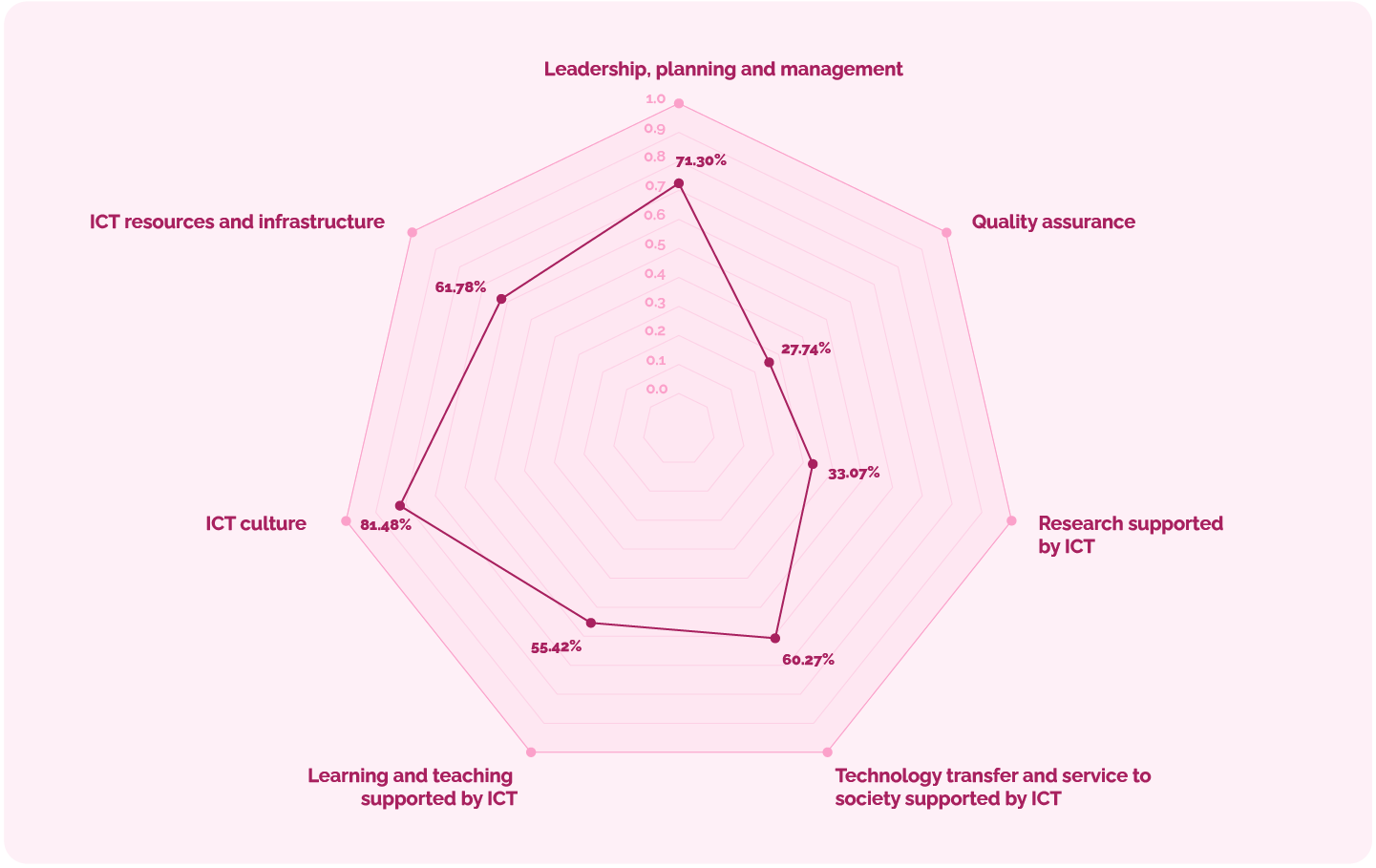
Figure: Digital maturity of a higher education institution by DMFHEI areas
Background Colour
Font Face
Font Size
Text Colour
Font Kerning
Image Visibility
Letter Spacing
Line Height
Link Highlight
Paragraph Width
Text Alignment