2. Introduction to Learning Design and Instructional Design Models
2. Introduction to Learning Design and Instructional Design Models
The aim of this chapter is to introduce five relevant models:
Three learning design models:
-
ABC Learning Design
-
OULDI (Open University Learning Design Initiative)
-
BDP (Balanced Design Planning)
Two instructional design models:
-
ADDIE (Analysis, Design, Development, Implementation, Evaluation)
-
Gagné’s model
Models of learning designs
ABC Learning Design (University College London)
The ABC Learning Design model was developed at University College London (UCL) and is based on six learning types defined by Diana Laurillard: acquisition, discussion, investigation, practice, collaboration, and production. The ABC model is primarily applied in a workshop format in which teachers collaboratively plan a course using visual cards that represent different learning activities. Its main advantages are speed, collaboration, and a strong focus on the student experience. A limitation is the reduced depth of analysis regarding assessment elements and the achievement of learning outcomes.
OULDI (Open University Learning Design Initiative)
OULDI is a model developed by The Open University in the United Kingdom. The model is based on representing learning and teaching through different forms (graphical, textual, network-based), which encourages reflection and an analytical approach to design. OULDI includes the use of tools such as CompendiumLD, which enables the visualization of the teaching process and the involvement of participants. The emphasis is on structuring content, selecting resources, and clearly defining the role of the teacher and the student at each step. OULDI is less suitable for rapid implementation but is a powerful tool for more complex learning designs.
Balanced Design Planning (BDP) (FOI, University of Zagreb)
BDP is a model developed in the European context (Rienties et al., 2023), led by the Learning Analytics Laboratory at the Faculty of Organization and Informatics, University of Zagreb. The model was developed by Divjak et al. (2022) and is based on student-centred design and constructive alignment aligned with the modalities of delivery. By using a free online collaborative tool (learning-design.eu), BDP enables the analysis and visualization of the alignment of design elements and identifies discrepancies that may affect the quality of implementation. A specific feature of this model is its systematic approach to integrating constructive alignment and assessment.
Models of Instructional Design
ADDIE (Analysis, Design, Development, Implementation & Evaluation) Model
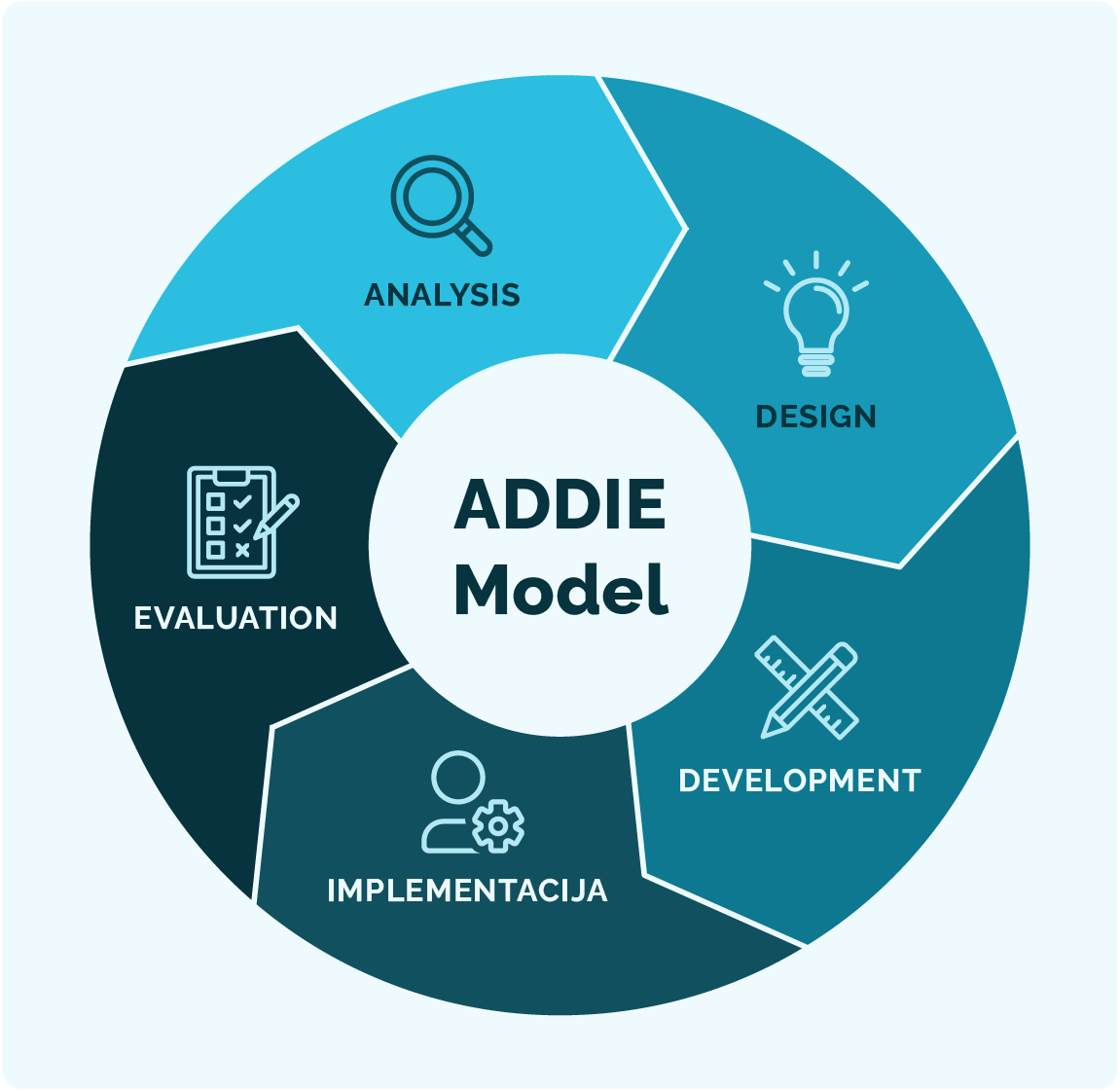
ADDIE is one of the most well-known models of classical instructional design, initially used in military training environments and later adopted in corporate training and education. The ADDIE model was developed by the Center for Educational Technology at Florida State University in the early 1970s, primarily for the training needs of the U.S. military. The name is an acronym for the five phases of instructional design: Analysis, Design, Development, Implementation, and Evaluation.
ADDIE is a process-oriented model that enables a systematic approach to creating educational materials. The focus is on needs analysis, formulating objectives, developing materials, and evaluating them. Its advantage is universality and structure, but a potential drawback is limited flexibility in rapidly changing educational contexts.
Gagné’s Nine Events of Instruction
Robert Gagné (Gagné, 1985; Gagné et al., 1992) developed a model of nine instructional events that correspond to the cognitive processes required for successful knowledge acquisition. The steps include gaining attention, informing learners of the objectives, stimulating recall of prior knowledge, presenting the content, providing learning guidance, eliciting performance, giving feedback, assessing performance, and ensuring transfer. Gagné’s model is highly precise and suitable for structured teaching, especially in STEM and technical subjects. However, in contemporary contexts, it may at times be considered too linear and inflexible.
Background Colour
Font Face
Font Size
Text Colour
Font Kerning
Image Visibility
Letter Spacing
Line Height
Link Highlight
Paragraph Width
Text Alignment