3. What to investigate?
Focus your analysis on four key aspects:
1. Prior knowledge and experience
Which courses have students previously taken (e.g., course prerequisites)?
What is their general prior knowledge in the subject area covered by the course?
Do students have practical experience (e.g., internships, employment, or secondary school experience)?
Are students generally interested in the course?
2. Approaches to learning
How do students typically approach learning – superficially (focused on reproduction) or deeply (focused on understanding)?
Do they prefer independent work, teamwork, learning through practice, or digital materials?
Do they have developed digital competencies?
3. Demographic and contextual characteristics
What are the age and gender characteristics of your student group?
Are there international students, students who work alongside their studies, or students with special needs?
Are there students with specific learning difficulties or other needs that require adaptations in the learning design (UDL)?
At which study level and year are they enrolled (e.g., undergraduate, graduate)?
4. Students’ digital literacy and access to technology
How skilled are students in using digital tools?
Have they used digital tools in courses preceding yours?
Do students have their own equipment (e.g., a computer) or can they use equipment available at the university?
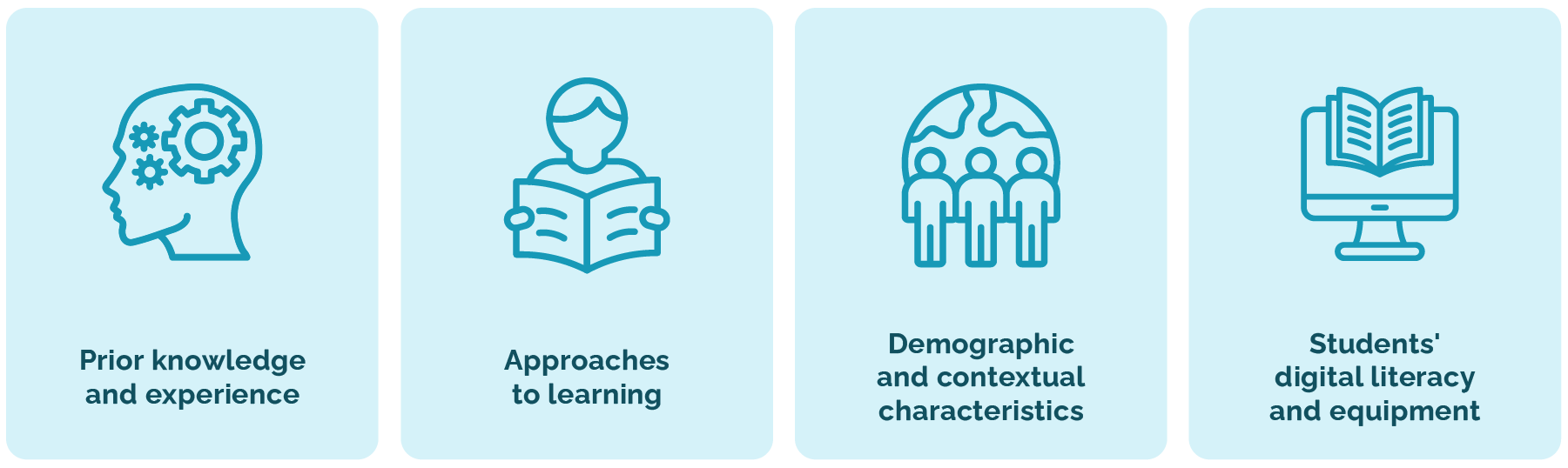
Figure 8: Student Characteristics
Background Colour
Font Face
Font Size
Text Colour
Font Kerning
Image Visibility
Letter Spacing
Line Height
Link Highlight
Paragraph Width
Text Alignment