3. Structure of the e-course
The e-course consists of an introduction, five topics, and a course conclusion. The following table shows the percentage to which each topic contributes to an individual learning outcome.
Table 1. Contribution of topics to the achievement of individual outcomes
Topic |
Formative assessment |
Summative assessment |
Analyse potential risks and challenges associated with the use of digital technologies in education. (20) |
Develop strategies and guidelines for the responsible use of digital technologies in the educational environment to ensure safe, stimulating, and ethical digital experiences. (30) |
Develop strategies and guidelines for ensuring the physical and psychological well-being of students, teachers, and management staff. (30) |
Create teaching content using digital technologies to support student progress on an individual level and ensure their well-being. (20) |
|
Introduction to the e-course |
0 |
0 |
5 % |
|||
|
Introduction to the impact of digital technologies on well-being |
10 |
0 |
25 % |
|||
|
Risk analysis of digital technologies in education and their impact on well-being |
5 |
10 |
70 % |
|||
|
Development of guidelines for the responsible use of digital technologies |
0 |
20 |
100 % |
|||
|
Development of guidelines for ensuring the well-being of employees and students of higher education institutions |
0 |
30 |
100 % |
|||
|
Implementation and evaluation of developed guidelines |
5 |
20 |
95 % |
|||
|
Course conclusion |
0 |
0 |
5 % |
|||
|
Total |
20 |
80 100 |
100 % |
100 % |
100 % |
100 % |
Structure of the e-course
Topic 1: Introduction to the impact of digital technologies on well-being
-
- In the theoretical sense, within this topic, participants will become familiar with the basic concepts related to well-being and the impact of digital technologies on well-being. The concept of well-being in the information society will be analysed, and digital well-being will be explored in more detail, including its relationship with mental health. Furthermore, trends and the future of digital technologies in education, such as artificial intelligence (AI), learning analytics, augmented and virtual reality, and their direct impact on the well-being of students, teachers, and other staff of higher education institutions, will be analysed. Potential risks and challenges associated with the application of digital technologies in education will be examined. Participants will need to study the prepared external sources on well-being in the information society, examine the designated strategic documents, and selected sources consisting of reports, guidelines, an overview of challenges, and recommendations for ensuring well-being.
Topic 2: Risk analysis of digital technologies in education and their impact on well-being
-
- Within this topic, the advantages and disadvantages of applying digital technologies in education will be analysed, and associated risks identified. Special attention will be paid to the security aspects of digital technologies, with an emphasis on privacy and personal data protection. Furthermore, ethical issues arising from the use of digital technologies in education and the challenges associated with fake news and digital information chaos will be explored. The topic will also include an analysis of digital addiction and its impact on the mental health of students, teachers, management, and administrative staff.
- In a practical sense, based on the studied materials, participants will need to create a SWOT analysis of the impact of digital technologies on well-being in their own higher education institution, covering strengths, weaknesses, opportunities, and threats. As part of the practical part of the unit, participants will need to find an article or study to analyse, in which the results of research on the impact of digital technologies on the well-being of stakeholders in higher education are presented and interpreted. On the forum, they will need to share a link to the article/study and provide their own reflection in the form of a short review of the article/study, and express a critical opinion on the content and results. Given that this is a Forum resource, the teacher and participants will be able to discuss the aforementioned critical review. Topic 3: Development of guidelines for the responsible use of digital technologies
- This unit will cover the development of guidelines for the responsible use of digital technologies, setting standards and rules for the use of technologies with an emphasis on supporting the well-being of everyone involved in education. This includes rules for using tools within teaching, rules for using tools within the organisation, and rules for the responsible use of digital tools. Also, ethical aspects in the creation and use of digital content, including the definition of ethical guidelines in the use of digital tools, will be analysed. A special part of the topic is dedicated to the sustainable use of digital tools and resources, with an emphasis on resource efficiency and the sustainability of tools and resources.
- In the practical part, participants will discuss legal guidelines and responsibility in the use of digital materials with a focus on the well-being of students, teachers, administrative, and management staff. In the first part of the synchronous activity, participants should reflect on the document they selected and studied as part of the previous activity of studying external sources, present the basic strategies they identified as important and that should be applied in their higher education institution, and conduct a discussion on it. In the second part of the synchronous activity, participants talk about their own experiences and observed trends in their environment relating to the responsible and safe use of digital technologies. The discussion is moderated by a mentor. The mentor evaluates the participants' presentation and the exchange of their own experience and presentation of examples. Also, within this topic, a discussion is planned in such a way that the participants themselves choose an ethical challenge to discuss in the form of a debate, asynchronously on the forum, to make the discussion as interesting as possible and to include all participants. As part of the practical part, participants will need to create a proposal for strategies for the responsible application of digital technologies in their higher education institution based on the studied materials and examples of guidelines. The strategies should be focused on the safety, responsibility, legal, and ethical aspects of the application of digital technologies and are an integral part of the guidelines. They can be defined based on an analysis of example guidelines, and in this way, strategies suitable for one's own higher education institution can be selected and defined. Strategies are those that will ensure the acceptance of guidelines in higher education institutions. The participant submits a document, "Guidelines for the Responsible Use of Digital Technologies," which contains defined strategies for their higher education institution.
Topic 4: Development of guidelines for ensuring the well-being of employees and students of higher education institutions
-
-
-
- In the theoretical part, the focus is on an in-depth analysis and understanding of the key elements necessary for creating strategic guidelines. This part includes determining strategic areas, objectives, activities, and indicators that are essential for ensuring the well-being of employees and students of higher education institutions. Participants will study the prepared materials, which will contain proposals for strategies for ensuring well-being in educational institutions and a framework for improving student well-being at universities. An integral part of these materials will also be content that will help participants define proposals for strategic areas, objectives, activities, and indicators. The purpose of this theoretical framework is to provide participants with a solid foundation of knowledge and tools needed for the subsequent creation of comprehensive strategic guidelines for ensuring the well-being of all stakeholders in higher education institutions.
- In the practical part, participants will discuss, exchange experiences, and ideas in a virtual room based on the current situation at the higher education institution, the lessons learned, articles, strategic documents, and reviewed video materials on the topic of guidelines for ensuring the well-being of employees and students of higher education institutions. By participating in the discussion, participants present an initiative for ensuring well-being according to the areas, objectives, and activities of the guidelines. The practical part also includes the definition of key strategic areas, objectives, activities, and indicators important for ensuring the well-being of employees and students. Based on theoretical findings and defined elements, participants will need to create a guideline document with a special emphasis on defining areas, objectives, and proposed activities and indicators for improving well-being. To successfully complete the task, they will first need to form teams of three participants. It is recommended that the teams consist of participants from the same faculty or university to facilitate collaboration on the creation of the guidelines. The goal of these practical tasks is twofold. The first step is identifying strategic areas and defining objectives for ensuring the well-being of stakeholders in higher education institutions, especially in the context of digital technologies. These initial proposals for areas and objectives will form the basis of the guidelines for ensuring well-being that participants elaborate on in greater detail in the next task. After that, based on already defined strategic areas and objectives, the teams will create specific guidelines and strategies for ensuring the well-being of employees and students with an emphasis on the integration and impact of digital technologies. It is important that the proposal includes specific activities, a resource allocation plan, and measurable indicators of success. Teams will need to complete the task and submit the finished guidelines to the system. Evaluation of the strategic guidelines will be conducted through peer assessment. Participants will evaluate the strategic guidelines of other teams according to the given criteria, where each team will be obliged to evaluate at least one set of guidelines from another team. The mentor will also evaluate the submitted guidelines.
-
-
Topic 5: Implementation and evaluation of developed guidelines
-
-
-
-
- In the theoretical part of the topic "Implementation and evaluation of developed guidelines," the focus will be on the comprehensive process of ensuring well-being in higher education institutions, with a special emphasis on the implementation of strategies and guidelines and the creation of teaching content that contributes to ensuring digital well-being.
- In the practical part, participants will first need to analyse how data are collected with the aim of monitoring and evaluating strategies. This includes finding and describing a specific example of evaluation, applying a well-being strategy within their higher education institution. The goal is to understand and critically analyse the existing processes of monitoring and evaluation, including determining who is responsible for collecting and analysing data. After that, participants will need to create teaching content. The goal of this task is to apply the acquired knowledge of guidelines and strategies for well-being, especially in the context of digital technologies, by developing a short piece of teaching content (e.g., task, presentation). The content must be designed according to the principles of well-being and use digital technologies in a reliable, safe, and responsible manner. The use of generative artificial intelligence for creating content or images is allowed, with mandatory critical review of the generated material. Finally, participants will need to participate in a virtual room where they will discuss and exchange experiences and ideas. The discussion will be based on the current situation at their university/faculty, the studied lessons, articles, and video materials. The main topics will be how to prepare and implement guidelines in one's own institution and how to create teaching content that contributes to ensuring digital well-being.
-
-
-
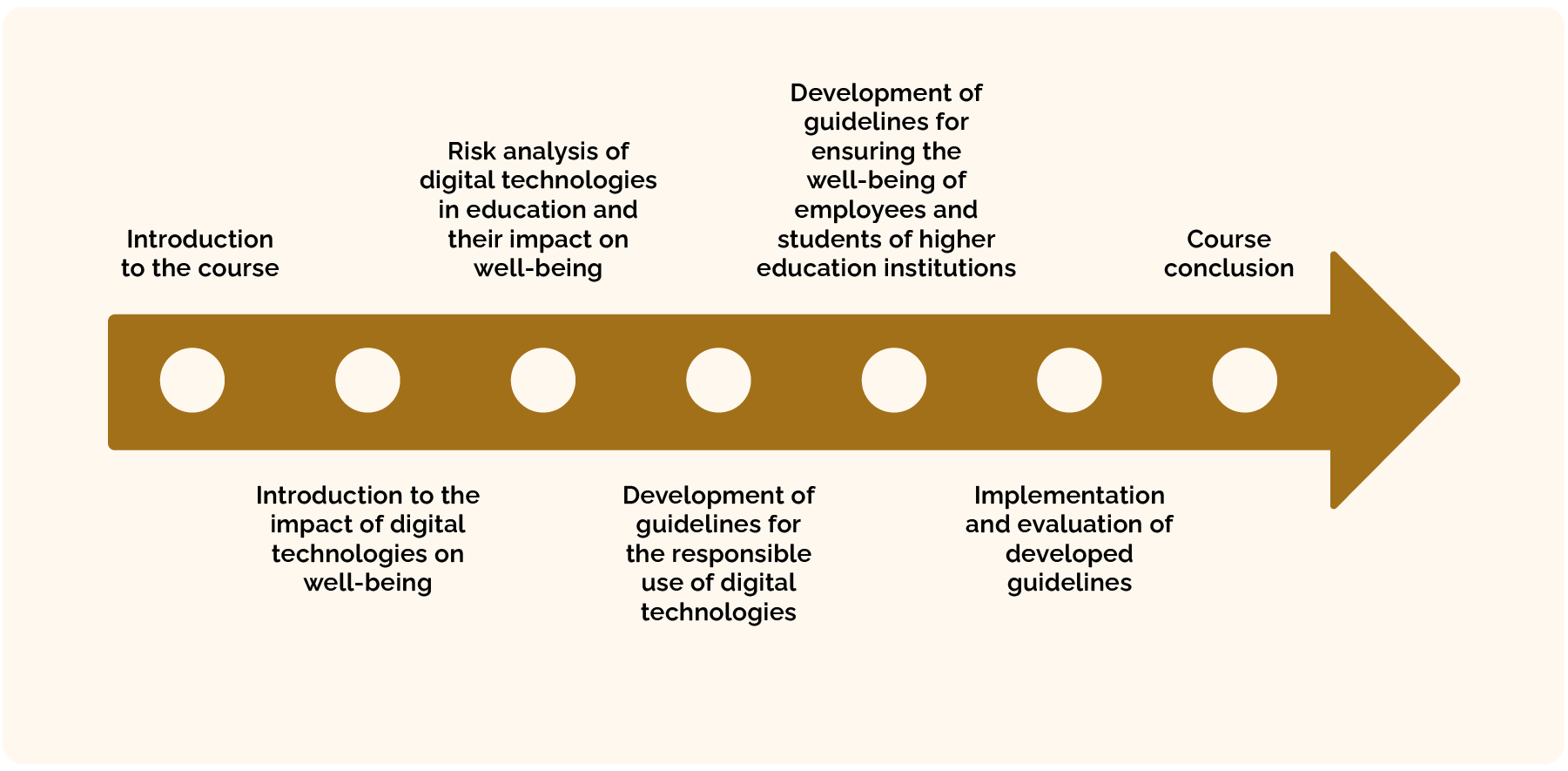
Figure: Display of summative assessment
Background Colour
Font Face
Font Size
Text Colour
Font Kerning
Image Visibility
Letter Spacing
Line Height
Link Highlight
Paragraph Width
Text Alignment