4. Artificial Intelligence (AI)
Of all digital trends, artificial intelligence (AI) has the greatest impact on education, enabling personalised learning, adapting content, and automating administrative tasks. This technology brings a significant reduction in stress for students as they can learn at their own pace, receive rapid and targeted feedback, and feel greater control over their educational path. Such an approach fosters motivation and reduces academic anxiety, which is crucial for their psychological well-being.
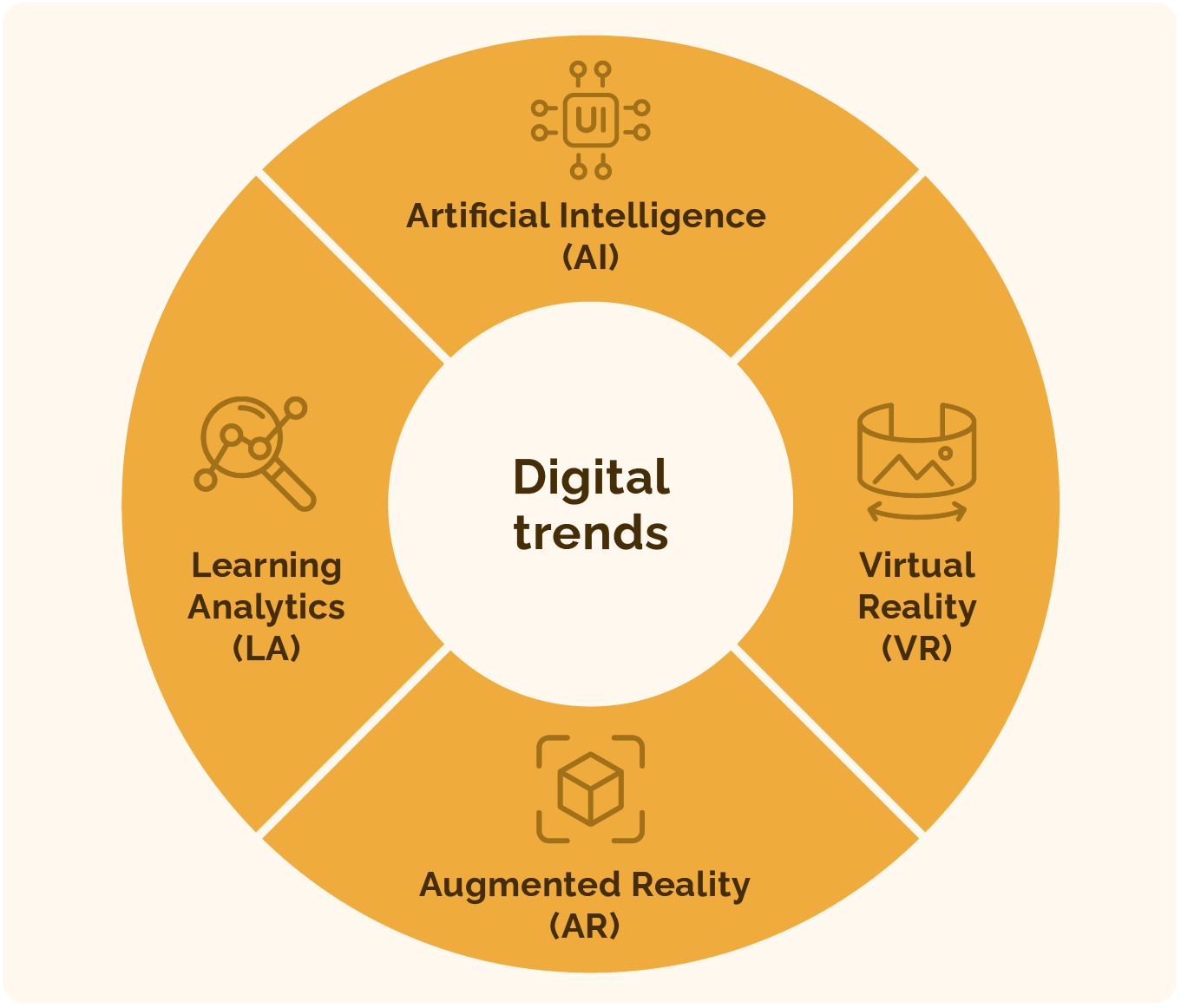
Figure 6. Digital trends
On the other hand, by using AI, teachers and management staff can drastically reduce the administrative burden, such as grading and data processing, freeing up time for creative and strategic activities like mentoring and curriculum development. This increases their professional well-being and job satisfaction.
However, it is important to be aware of the challenges of applying AI, such as the problem of "hallucinations" in AI models, and to ensure ethical and responsible implementation. For students, the main risks include a potential reduction in critical thinking due to over-reliance on AI tools, issues with academic dishonesty (plagiarism), the transfer of bias from AI models, the risk of misinformation (AI "hallucinations"), and the compromising of data privacy.
Teachers face an increased workload due to the need to detect misuse. Some show resistance to change due to insufficient preparation, and another issue is the possible reduction in direct interaction with students. Questions regarding copyright on AI-generated content also remain open.
Additionally, higher education institutions must deal with the cybersecurity challenges of complex AI systems, the complexity of managing such systems, and unresolved issues of responsibility in the event of AI errors.

Image source: Shutterstock
Background Colour
Font Face
Font Size
Text Colour
Font Kerning
Image Visibility
Letter Spacing
Line Height
Link Highlight
Paragraph Width
Text Alignment