3. Hybrid learning
Hybrid learning represents a combination of a traditional educational environment with the support of e-learning. It is currently the most widespread form of learning, as it enables student-centered learning. Namely, all the advantages of distance learning, such as access to education anytime, anywhere, are used here, and the sharp boundaries between the two learning methods are lost. This form represents the application of a new educational paradigm in which investigative and collaborative learning is encouraged, and the teacher becomes the leader throughout the learning process.
In the hybrid type of learning, it is assumed that students remain connected to colleges and universities (meaning they don't have to be far away), but all the possibilities offered by technology today remain at their disposal to meet their needs and facilitate and improve the learning process, including lifelong education.
E-learning encourages exploratory learning and teaching, and compared to traditional classroom teaching, some of the advantages, according to Bates (2004), are:
- students have access to high-quality teaching and learning anytime, anywhere
- information that could previously only be provided by a teacher is now available on demand via the Internet.
If multimedia teaching materials are of high quality and well designed for learning, they can be more effective than traditional classroom teaching, because students acquire knowledge faster with the help of illustrations, animations, different structuring of the material, and when they have greater supervision or greater interaction with the teaching material.
New technologies can be designed to develop high-level skills such as problem-solving, decision-making, and critical thinking. Interaction with teachers can be organised and managed through online communication to ensure greater accessibility and adaptability for both students and teachers. Computer-assisted communication can facilitate team teaching, collaboration, and communication with teachers from other institutions, and the creation of multicultural and international student groups.
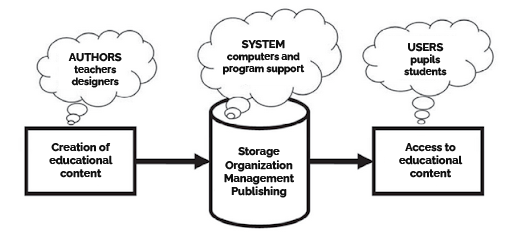
E-learning is a generic term that includes all types of distance learning, computer-based learning, and the Internet or intranet. Although it primarily refers to learning in an electronic environment outside the framework of physical institutions, today it increasingly refers to learning in an electronic educational environment, which also includes the so-called hybrid learning (blended learning), i.e., a combination of physical and virtual educational environments. It is important to emphasize that e-learning and the environment in which it takes place consist of three main components: the teacher or author who creates educational content, the system in which this content is stored and organised, and the user, i.e., the student or participant. Given the technological capabilities and the institution that organises e-learning programmes, these components can be expanded or narrowed, but the main idea remains the same.
The image shows the basic components of an electronic educational environment.
Background Colour
Font Face
Font Size
Text Colour
Font Kerning
Image Visibility
Letter Spacing
Line Height
Link Highlight
Paragraph Width
Text Alignment