1. Introduction
SWOT analysis is an analytical framework that enables the systematic identification of strengths, weaknesses, opportunities, and threats. In the academic environment, it is applied at the level of an institution, study program, or individual project to assess their alignment with educational strategies and development goals, and evaluate the quality of implementation of teaching and research activities.
SWOT analysis was developed in the 1960s and 1970s by researchers at Stanford University, as part of a project funded by Fortune 500 companies. Their goal was to find the reasons for unsuccessful corporate planning and to design a more effective change management system. They originally designed the SOFT (Satisfactory, Opportunity, Fault, Threat) framework, which was later modified at Harvard into today's SWOT (Strengths, Weaknesses, Opportunities, Threats).
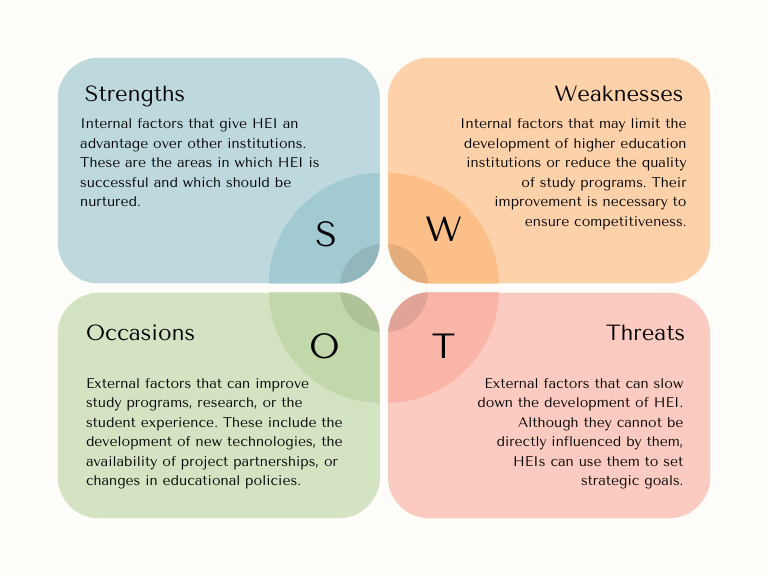
SWOT analysis allows you to identify internal strengths and weaknesses and external opportunities and threats. It is presented in the form of a matrix with four quadrants, each representing one element:
- Strengths
- Weaknesses
- Opportunities
- Threats.
The following link is available in Croatian only. Participants may use free AI-powered translation tools to access the provided materials.
We recommend that you read a useful resource related to conducting a SWOT analysis (from page 3 onwards) available at the link (Krečak, 2025).
Background Colour
Font Face
Font Size
Text Colour
Font Kerning
Image Visibility
Letter Spacing
Line Height
Link Highlight
Paragraph Width
Text Alignment