6. TPACK framework
What is TPACK?
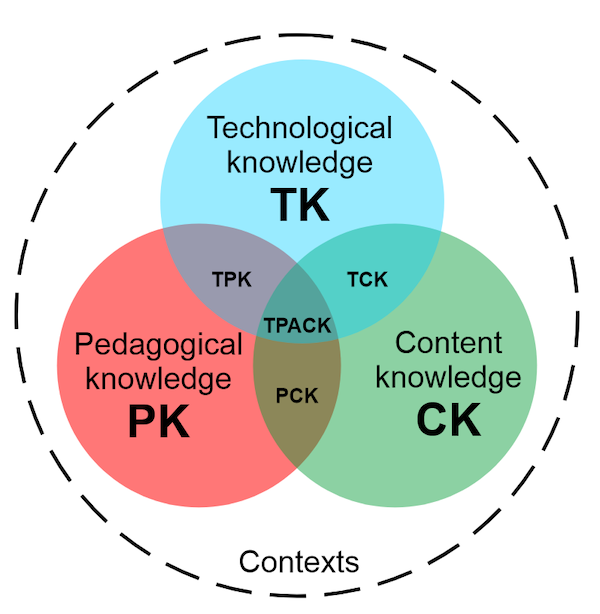
TPACK stands for Technological Pedagogical Content Knowledge. At the heart of the TPACK framework is TPACK knowledge, an integrated understanding of how to teach specific content using appropriate pedagogical strategies supported by appropriate technology. The model assumes that quality teaching with technology requires a focused overlap of three knowledge areas (CK, PK, and TK, whose additional intersections then encompass new sub-areas):
Subject Content Knowledge (CK)
The teacher's knowledge of the subject is to be learned or taught; it includes knowledge of concepts, theories, and ideas, organisational frameworks, evidence, as well as established practices and approaches for developing such knowledge.
Pedagogical Knowledge (PK)
Teacher knowledge of the processes, practices, or methods of learning and teaching includes, among other things, the overall purpose of education, its values and goals; relates to understanding the learning process, classroom management skills, lesson planning, and assessment.
Technological Knowledge (TK)
Knowledge of certain ways of thinking and working with technology, tools, and resources; working with technology can be applied to all technological tools and resources; includes a broad enough understanding of information technology to apply it productively at work and in everyday life, recognising when information technology can help or hinder goal achievement, and constantly adapting to information technology changes/developments.
Pedagogical Content Knowledge (PCK)
It is based on Shulman's idea of pedagogical knowledge applicable to the teaching of certain content; the emphasis is on the transformation of the teaching topic that occurs during its interpretation, finding different ways of interpreting it and adapting instructional materials to alternative concepts and prior knowledge; it covers the very core of the work of teaching, learning, curriculum, assessment and reporting.
Technological Content Knowledge (TCK)
Understanding how technology and content influence and constrain each other. Teachers must master more than the subject matter they teach; they must also have a deep understanding of how the subject matter (or the kinds of representations that can be constructed) is transformed by the application of technology. Teachers need to understand which specific technologies are best suited to addressing subject matter learning in their domains and how content dictates or even changes technology, or vice versa.
Technological Pedagogical Knowledge (TPK)
It represents an understanding of how teaching and learning can change when certain technologies are used in a specific way, which includes knowing the pedagogical advantages and limitations of a range of technological tools related to discipline and developing appropriate pedagogical designs and strategies.
Technological Pedagogical Content Knowledge (TPACK)
A combined form of knowledge that contains all three main components (content, pedagogy and technology); it is the foundation of effective teaching with technology, requiring an understanding of the concepts of technology application, pedagogical techniques that use technology in constructive ways for the purpose of teaching material, knowledge of what makes certain concepts difficult or easy to learn and how technology can help correct some of the problems that students (learners) face; knowledge of students' (learners') prior knowledge and theories of epistemology; and knowledge of how technologies can be used.
Why is TPACK important?
The model helps teachers to see technology not as an add-on to teaching, but as an active component of didactic reflection. By applying the TPACK framework, the teacher reflects on these questions:
- What is the goal of teaching?
- What content is key to understanding?
- Which method best suits the goals and content?
- What digital tools can enhance the learning experience?
In this way, technology becomes a means, not an end, and supports learning in a meaningful and effective way.
Applying the TPACK framework in lesson planning
When planning levels of technology integration, TPACK can be used as a tool for analysis and reflection:
- Low level of integration: technology is used passively, for the presentation of content.
- Medium level of integration: technology enables interaction and collaboration.
- High level of integration: technology is inseparable from the teaching process, enabling personalized, creative, and problem-based learning.
TPACK also helps teachers develop digital competencies, as it emphasizes not only the technical, but also the pedagogical function of technology.
TPACK and professional development of teachers
Developing TPACK competencies does not happen automatically. It is necessary to include the TPACK framework in teacher education and professional development, encourage teamwork and interdisciplinary projects, use reflective practice, i.e., analysis of one's own teaching scenarios with the TPACK model, and apply digital pedagogy in designing e-courses and OER content for teachers to fully acquire these competencies.
The TPACK framework provides a systematic approach to understanding and integrating technology into the educational process. Rather than using technology haphazardly or out of a need to modernise or because it's "modern," TPACK directs us toward thoughtful and contextualised application. Such an approach not only improves teaching but also strengthens the role of the teacher as a pedagogical expert in the digital age.
Example of using TPACK in practice
A higher education teacher who applies the TPACK framework in planning activities starts with a balanced connection of three types of knowledge: technological, pedagogical, and substantive. When planning the course, the teacher first defines the learning outcomes related to the key terms in the field (content knowledge). He then chooses a pedagogical approach that encourages active student participation — for example, collaborative learning through discussions or case studies (pedagogical knowledge). To support this approach, he decides to use digital tools such as Moodle forums or interactive whiteboards (technological knowledge).
In the activity, students analyse real examples from practice, discuss them in an online environment, and jointly create a digital representation of the solution to the problem. The teacher monitors the discussion, asks questions that encourage deeper understanding, and offers real-time feedback. In this way, technology is not an end, but a means that supports the pedagogical goal and understanding of professional content. Through reflection after the activity, the teacher evaluates the effectiveness of the selected tools and approaches and adjusts the design of the following teaching units as necessary. Such integration shows the full application of the TPACK framework in the planning and execution of lessons in a digital environment.
Background Colour
Font Face
Font Size
Text Colour
Font Kerning
Image Visibility
Letter Spacing
Line Height
Link Highlight
Paragraph Width
Text Alignment