8. OER contents
Introduction
Open Educational Resources (OER) are digital contents for learning, teaching, and research that are freely available, adaptable, and redistributed under licenses that enable open use. The use and production of OER content is increasingly recognized as a key strategy for improving the quality of education, increasing accessibility, and encouraging collaboration among teachers.
1. What is OER content?
Open Educational Resources (OER) encompass a variety of materials that can be freely used in education, research, and self-directed learning. These include digital textbooks, interactive simulations, presentations, tests, various interactive activities, as well as multimedia content such as videos, audio recordings, and texts. Some OER projects also offer complete e-courses that can serve as a foundation for learning or as a complement to existing programs.
OER contents are most often published under Creative Commons licences, which clearly define the terms of use, processing, and sharing. This enables teachers and students to be not only passive users, but also active creators: they can freely adapt the contents to their own context, upgrade them with examples, translations, or new activities, and share them again with others.
If you want to learn more about CC licenses, you can do so at this link.
2. Benefits and challenges of incorporating OER into teaching
The inclusion of open educational resources (OER) in teaching brings several significant benefits for students and teachers. First, OER increases the accessibility of educational materials by removing financial and geographical barriers, as students from different parts of the world can use the same textbooks, courses, or multimedia content without additional costs. The flexibility of use allows teachers to select, adapt, and combine materials according to their own needs and course objectives, while students can learn at the pace that suits them best.
In addition, OERs encourage open pedagogy, an approach in which students and teachers actively participate in the creation and adaptation of content. This develops a sense of community and responsibility for learning. The use of OERs also encourages collaboration and the exchange of good practices among teachers, as materials are freely shared, improved, and built upon. Finally, open content reduces the cost of education, which allows students and institutions to have more equitable and sustainable access to knowledge.
The challenges of using OER include the variable quality of the material (which should always be checked before including it in your own e-course or teaching), the need for regular content updates, technical sustainability, and sometimes insufficient visibility of the available content (if downloaded from external sources). Teachers also need to invest additional time and support in adapting OER to their own context (significantly less than if they were to create them from scratch, but this should still be considered).
3. Creating OER content – pedagogical, technical, and legal aspects
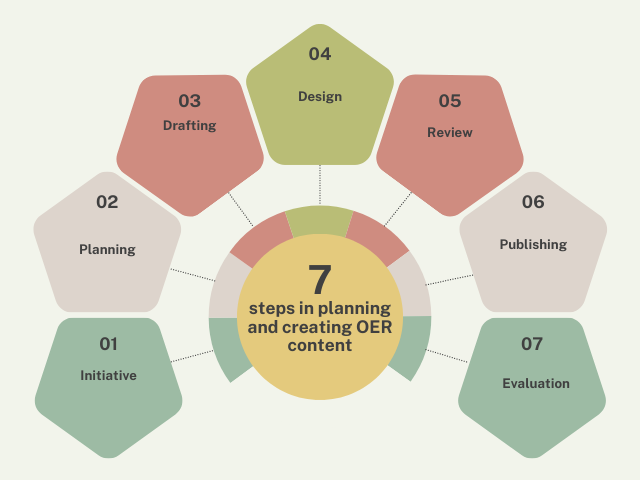
The creation of open educational content (OER) requires careful planning and coordination of pedagogical, technical, and legal aspects.
From a pedagogical point of view, it is important that the contents are clearly linked to the learning outcomes, structured in a logical and transparent way, and adapted to different learning styles. Teachers should use methods that encourage interactivity and engagement, for example, through tests, multimedia content, or self-checking tasks.
The technical aspect involves choosing formats and tools that allow for easy creation, sharing, and reuse of materials. Popular tools for creating OER include H5P for interactive content, Canva for creating graphics and presentations, Audacity for recording and editing audio, OBS Studio for recording and streaming lectures, and Moodle LMS for publishing and organizing content into e-courses. Accessibility is key, and therefore, content should be compatible with screen readers, mobile-friendly, and technically stable.
The legal aspect refers to the respect of copyright and the selection of an appropriate license. The most often used are Creative Commons licenses, which clearly define the terms of sharing, processing, and commercial use. Authors should be careful about the use of images, texts, and multimedia from external sources and check whether they have permission to include them.
In addition, attention should be paid to the quality of the material, ensuring that the content is up-to-date, accurate, methodologically well-designed, and aligned with educational standards. In this way, OER becomes not only free but also quality content that truly contributes to education.
4. Platforms and tools for OER
There are numerous platforms that offer access to OER content. Examples include OpenStax (digital textbooks), OER Commons (open repository of educational materials), MERLOT (multidisciplinary content database), and MIT OpenCourseWare (full contents of e-courses) or Khan Academy (interactive courses and video materials). Such sources significantly contribute to the democratisation of education and encourage a culture of knowledge sharing.
5. The role of teachers and institutions
The successful inclusion of open educational content (OER) requires a combination of individual teachers' efforts and institutional support that should facilitate their work. Teachers have a key role because they become designers of digital educational materials: they create new content, adapt existing OER materials to their educational context and the specifics of e-colleges, and continuously evaluate their quality and pedagogical value. Thus, they move from the traditional role of lecturers to active creators of knowledge. Such an approach requires developed digital and authoring competencies, which include knowledge of tools for creating digital content, understanding of the principles of open pedagogy, and awareness of copyright and licenses.
Institutions have a responsibility to create an environment that encourages teachers to use and develop OER. This includes systematically evaluating and recognising work on open educational content, offering professional development and training programs, as well as technical and advisory support. It is also important that institutions promote open education as part of their strategy and quality culture. Only by working together with teachers and institutions can the sustainability and wider use of OER in higher education be ensured.
Conclusion
OER contents are not only educational materials - they are a tool for the democratisation of knowledge, support for inclusive and quality education, and an opportunity to strengthen cooperation, innovation, and transparency in the education system. By actively engaging in the production and use of OER, teachers take an active role in shaping open, relevant, and sustainable education for the future.
You can find more information about OER in this course.
Background Colour
Font Face
Font Size
Text Colour
Font Kerning
Image Visibility
Letter Spacing
Line Height
Link Highlight
Paragraph Width
Text Alignment