9. Universal Design for Learning (UDL)
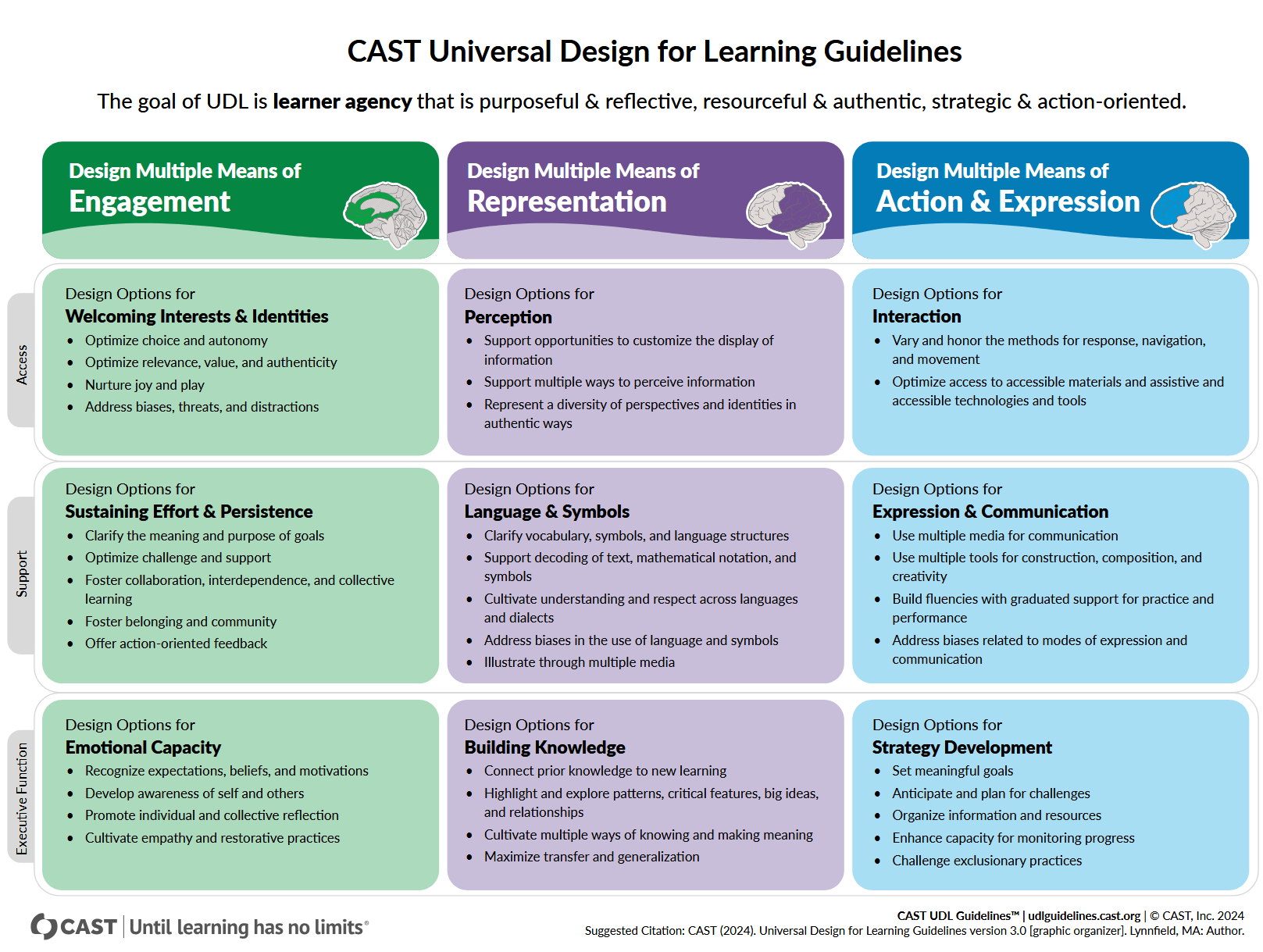
What are the guidelines for UDL?
The Universal Design for Learning (UDL) Guidelines are a fundamental framework for creating curricula and teaching units that provide the best access and results for every individual, initially created in 2008. More information is available here: https://udlguidelines.cast.org/. There are several versions of the UDL guidelines; the latest, from July 2024, is UDL 3.0 (more on this at: https://udlguidelines.cast.org/more/about-guidelines-3-0/).
- They are used in the development of curricula.
- The design process leads to flexible content and lessons that can be used by all students.
- It starts from the assumption that every student's brain is different and provides multiple opportunities to access each learning network so that each individual can learn in the best possible way for them.
- In addition to learning the content being taught, students will also understand its importance and how it can be applied in their context.
UDL guidelines shape the educational environment to support student autonomy, which should be:
- purposeful — internalised self-efficacy, acting in ways that are personally and socially meaningful
- reflexive — self-awareness and metacognition to recognise internal motivations and external influences that support learning and adaptations when necessary
- resourceful — understanding and applying an individual's advantages, strengths, resources, and linguistic and cultural capital
- authentic — increasing understanding and deepening understanding in authentic ways
- strategic — setting goals and monitoring learning through planning
- action-oriented — independent and group action in achieving learning goals.
UDL aims to change the design of the environment, not frame the problem as a perceived deficiency within the student. When environments are intentionally designed to minimise barriers, every student can engage in meaningful learning.
Designing learning environments that support student independence requires continuous examination of the relationship between educators and students and the creation of a space where students can individually and collectively understand content through interaction and reflection. Furthermore, supporting student independence requires recognising the dimensions of culture and identity and examining where prejudices and expectations can be obstacles for students to fully realize their independence.
In the context of online and hybrid learning, UDL guidelines provide a framework for designing activities that are accessible, flexible, and inclusive for all students. They encourage teachers to anticipate different ways of participating, expressing, and presenting content in a digital environment at the planning stage. The UDL approach allows for the adaptation of teaching materials to different learning styles and technical capabilities, thereby reducing barriers to participation in online activities. In this way, the digital environment becomes a space that supports individual differences and enables every student to actively and meaningfully participate in learning.
Quick tips about UDL
- Different groups — different materials — different activities.
- Working in a group (a common goal creates bonds and develops community belonging).
- Using various digital tools.
- Provide students with autonomy, the feeling that they can decide for themselves how they will learn (this will increase their motivation).
- Basis of work with students: TPS - Think-Pair-Share.
- Students with difficulties should have their activity time extended, and gifted students should be set different goals (more demanding, complex, and challenging).
Background Colour
Font Face
Font Size
Text Colour
Font Kerning
Image Visibility
Letter Spacing
Line Height
Link Highlight
Paragraph Width
Text Alignment