1. Introduction
In this activity, you will learn more about the types of assessment at the higher education level (including examples of digital tools through which they can be implemented). Assessment of student work and achievement represents one of the key components of any serious and high-quality educational process, especially in the context of higher education. It is not merely an administrative or formal obligation of teaching staff, but an integral part of pedagogical practice that profoundly influences the dynamics of teaching and learning.
This activity addresses fundamental concepts related to assessment, starting from basic definitions and purposes to various approaches that can be applied in practice. Special emphasis is placed on the development of methods that are not only reliable and fair but also pedagogically stimulating, motivating, and oriented toward the development of student competences.
Assessment should not be understood exclusively as a mechanism for assigning grades or merely categorising students based on their results. It represents much more than that, as it is a tool that can support learning, provide guidance for progress, and enable a deeper understanding of content.
For students, assessment provides insight into their own progress, weaknesses, and areas that require additional work. For teachers, on the other hand, assessment provides feedback on the effectiveness of their teaching methods, clarity of explanations, and alignment of learning outcomes with teaching activities. Well-designed assessment systems contribute to the creation of a higher-quality, reflective, and responsible educational environment. For example, analysis of student assignments can show how well a particular topic was understood; exam questions may reveal knowledge gaps among a larger group of students, while student course evaluations can provide insight into perceptions of assessment fairness.
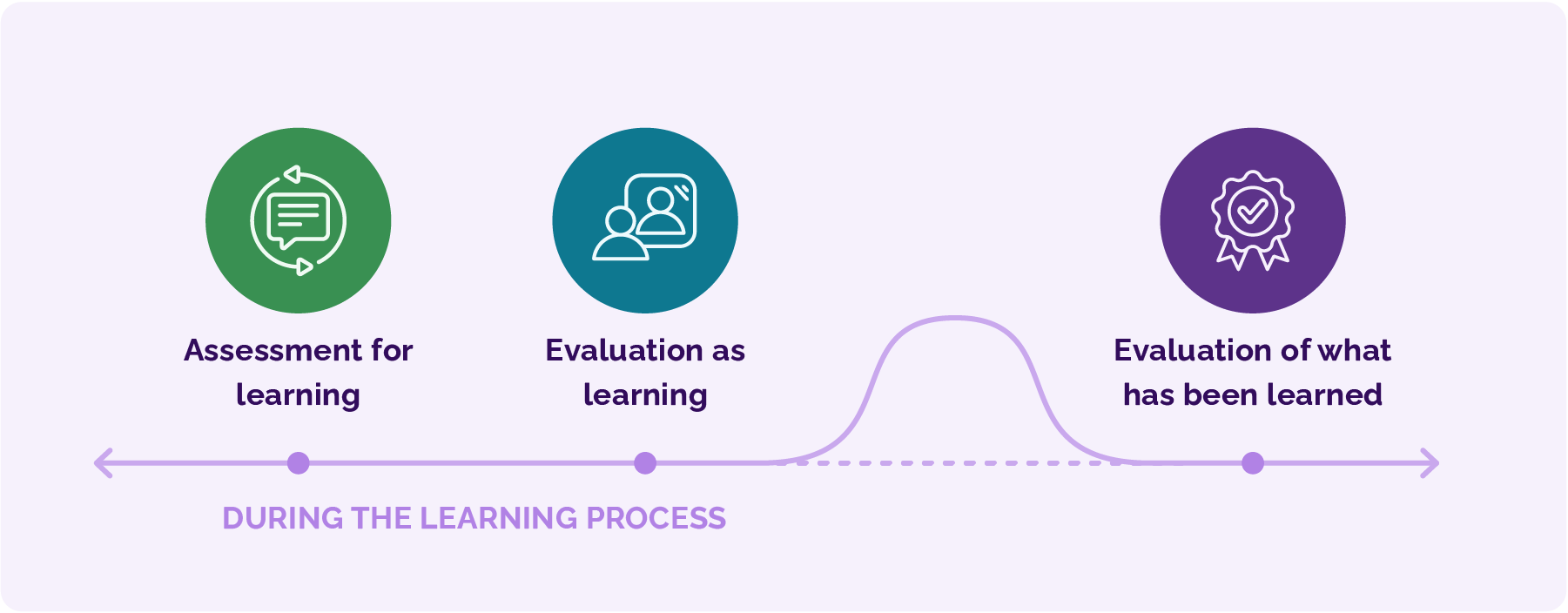
We distinguish three basic approaches to assessment:
Assessment for learning (diagnostic and formative functions) serves to improve and plan future learning and teaching. It is an integral part of the continuous teaching and learning process and takes place during instruction. It does not result in a grade, but in qualitative feedback and exchange of experiences related to learning processes and the acquisition of knowledge and skills in relation to defined learning outcomes.
Assessment as learning (peer assessment and self-assessment) implies the active involvement of students in the assessment process and the development of students’ autonomous and self-regulated approach to learning. Through peer assessment, students are actively involved in achieving learning outcomes, and they direct and adapt their learning toward goal attainment.
Assessment of learning (summative function) represents an evaluation of the level of student achievement after a certain period of learning and teaching. Through assessment of learning, information is summarised about what a student knows and is able to do at the end of a defined time period, in order to document and report on their achievements and progress.
This activity covers the following subtopics:
- phases of the assessment process
- diagnostic assessment
- formative assessment
- summative assessment
- assessment strategies and tools
- assessment and learning outcomes
- additional resources
Background Colour
Font Face
Font Size
Text Colour
Font Kerning
Image Visibility
Letter Spacing
Line Height
Link Highlight
Paragraph Width
Text Alignment